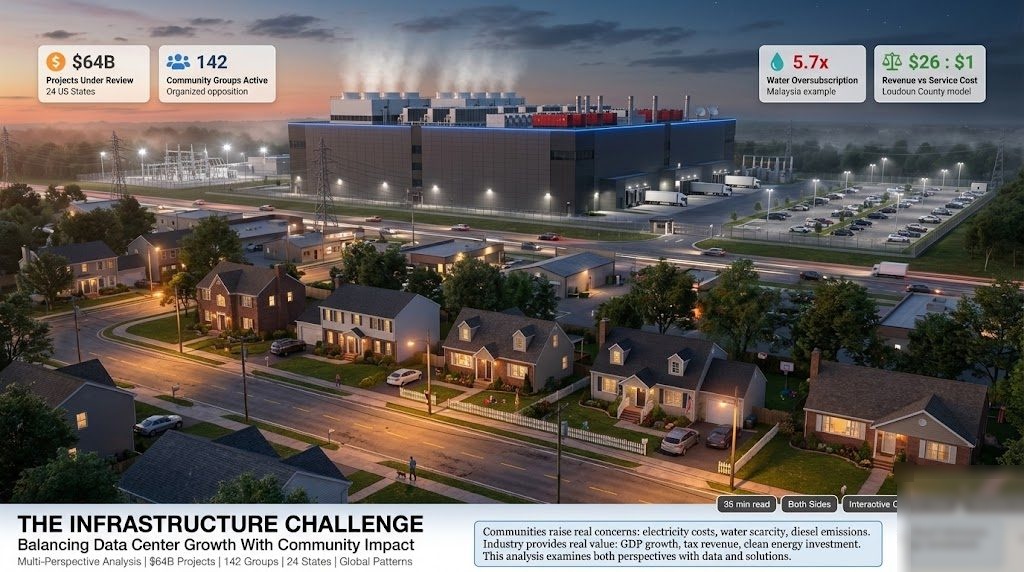
★ Key Findings at a Glance
$64 billion in US data center projects blocked or delayed by community opposition across 24 states — project cancellations quadrupled from 6 (2024) to 25 (2025)
Malaysia's first DC protest erupted February 7, 2026 in Johor — 50+ residents against a Chinese-owned facility, with water demand 5.7x exceeding supply
Carnegie Mellon projects 25% bill increases in Northern Virginia — Baltimore residents already saw $17/month spikes; data centers were 40% of PJM's $16.4B capacity auction cost
The industry defense is real: Loudoun County earns $26 per $1 of services from DCs — without DC investment, US GDP growth would have been 0.1% in H1 2025
Six US states introduced DC moratorium bills; Singapore, Ireland, and Netherlands pioneered regulatory frameworks — scroll to calculator to assess your community's net impact
Table of Contents
1.0 The Opening Salvo: From Virginia to Johor
On February 7, 2026, something unprecedented happened in Southeast Asia. Fifty residents of Gelang Patah, a district in Johor, Malaysia, gathered outside a construction site less than one kilometer from their homes. Their target: a 38-acre data center being built by Zdata Technologies, a Chinese-owned developer. Police watched as protesters held signs demanding answers about dust pollution, water scarcity, and the facility's impact on their daily lives.
This was Malaysia's first-ever public protest against a data center. But it was not an isolated event. It was the latest eruption in a global rebellion that has already blocked or delayed $64 billion worth of projects in the United States alone.
⚠ The Scale of Opposition
Between 2023 and mid-2025, community opposition in the US:
$18 billion in projects blocked outright
$46 billion in projects delayed over two years
142 activist groups across 24 states
25 project cancellations in 2025 alone — up from 6 in 2024 and 2 in 2023
Source: Data Center Watch, 2025; Heatmap News, 2025
For those of us who work inside data centers — maintaining generators, managing cooling systems, coordinating with grid operators — this backlash is not abstract. It is personal. The communities organizing against our industry have legitimate grievances. But the industry also provides genuine economic value that opponents rarely acknowledge. This article examines both sides, with data.
1.1 The Johor Water Crisis
The Johor protest did not emerge from nowhere. Malaysia's southern state hosts 47 data centers built or under construction, with dozens more planned. The data center applications across three Malaysian states have requested 808 million litres of water per day — but the available supply capacity is only 142 million litres per day. That is a 5.7x oversubscription.
Water Demand
Water Supply
Gap Ratio
In November 2025, Johor stopped approving Tier 1 and Tier 2 data centers entirely, citing water overuse. Investors were told to halt water-cooled expansion projects until mid-2027. Some operators, unable to wait, reportedly began purchasing water via tanker trucks — a crisis indicator in any infrastructure sector.
1.2 The American Parallel
The Johor protest mirrors patterns that emerged in the United States years earlier. In Warrenton, Virginia, voters replaced their entire town council and voted 6-0 to eliminate all data center zoning. In Louisa County, AWS withdrew a 7.2 million square foot proposal after community mobilization under the banner "Don't Loudoun my Louisa." In Chandler, Arizona, the city council unanimously rejected a $2.5 billion data center despite lobbying from former Senator Kyrsten Sinema.
| Location | Year | Outcome | Value |
|---|---|---|---|
| Chandler, AZ | Dec 2025 | Rejected 7-0 | $2.5B |
| Tucson, AZ (Amazon) | Aug 2025 | Rejected unanimously | 600MW campus |
| Louisa County, VA (AWS) | Jul 2025 | AWS withdrew | 7.2M sq ft |
| Goodyear/Buckeye, AZ | May 2024 | $14B withdrawn | $14B |
| Warrenton, VA | 2024-25 | All DC zoning eliminated | $39M site |
| New Orleans, LA | Jan 2026 | 1-year construction ban | Citywide |
Sources: Data Center Watch, Virginia Mercury, DCD, AZ Family, Axios For educational and research purposes only.
2.0 Follow the Money: The Electricity Bill Crisis
Community PerspectiveThe single most politically explosive issue is electricity costs — a dynamic we quantified in our analysis of AI data centers versus citizen electricity bills. When your neighbor's power bill rises while the data center next door negotiates below-market rates, the math becomes personal.
2.1 The Carnegie Mellon Projection
A joint study by Carnegie Mellon University and NC State University projected that data center and cryptocurrency mining electricity demand will grow 350% by 2030. The impact on consumer bills:
- National average: 8% increase by 2030
- Northern Virginia: Exceeding 25%
- Baltimore: $17/month increase already; $70/month projected by 2028
- Dominion Energy territory: $255/month residential bill projected by 2035
2.2 The PJM Capacity Crisis
The PJM Interconnection — the grid operator serving 65 million people across 13 states — held its December 2025 capacity auction. The results were devastating for ratepayers:
Total Auction Cost
DC Share
3-Auction Total
Reserve Margin
PJM's Independent Market Monitor took the extraordinary step of filing an emergency complaint with FERC, seeking to block grid operators from connecting new data center loads until supply reliability can be guaranteed. Without action, the region may fall below reliability standards by June 2027.
2.3 The Cross-Subsidy Problem
Harvard's Electricity Law Initiative published a landmark paper in March 2025 identifying three mechanisms through which data center costs are shifted to residential customers:
- Secret special contracts: Utilities negotiate discounted bilateral rates with DC operators through opaque regulatory processes. When the rate is below the utility's cost to serve, other ratepayers absorb the difference.
- Transmission cost allocation: PJM approved $5 billion in new interstate transmission projects largely for data centers. Maryland utilities will pay ~$500 million of this, passed to residential bills.
- Colocation arrangements: Behind-the-meter colocation between DCs and power plants can increase wholesale prices for all other customers.
2.4 The Political Consequences
Electricity Bills Are Now an Electoral Force
Virginia 2025: Democrat Abigail Spanberger won the governorship by 14 points on a platform that data centers must "pay their fair share." February 2026: Senators Hawley (R) and Blumenthal (D) introduced the bipartisan GRID Act — the first federal bill to prevent DC power usage from raising consumer bills. February 2026: Anthropic announced it will cover 100% of consumer electricity price increases from its data centers.
3.0 Water Wars: From Oregon to Johor
Water is the most potent community rallying point. Cited in over 40% of contested projects, water scarcity creates visceral, non-negotiable opposition.
3.1 The Dalles, Oregon
In 2021, Google's data center complex in The Dalles consumed 355 million gallons of water — 29% of the city's total supply — triple its consumption from a few years earlier. The local water table had dropped 15 feet in 15 years. When The Oregonian newspaper sought water usage data, Google paid $100,000 to fund the city's lawsuit against the newspaper to suppress the figures. The suit was ultimately dropped, revealing the data.
3.2 Tucson, Arizona
Amazon's Project Blue would have consumed ~2,000 acre-feet of water annually, making it Tucson Water's single largest customer. The city council unanimously rejected it. Amazon later withdrew entirely.
3.3 The Technical Reality
A large data center can consume up to 5 million gallons per day — equivalent to a town of 10,000 to 50,000 people. A single megawatt of traditional cooling requires approximately 26 million litres per year. Over 40% of planned and existing US data centers are located in areas classified as "high" or "extremely high" water scarcity.
4.0 The Air We Breathe: Diesel and Health
As someone who has operated and maintained these generators for over a decade, I can tell you: the gap between marketing and operational reality is significant.
4.1 The Virginia Diesel Crisis
Northern Virginia alone has approximately 9,000 permitted Tier II diesel generators with combined capacity exceeding 11 GW — more than Dominion Energy's entire natural gas fleet. The emissions trajectory:
CO Emissions Growth
NOx Emissions Growth
PM2.5 Growth
Virginia's JLARC found that in a worst-case scenario, these generators could release 9,000 tons of nitrogen oxides — equal to half of all annual NOx emissions in Northern Virginia from all sources combined. VCU researchers confirmed that Northern Virginia DC air pollution now rivals power plant emissions.
4.2 The Health Data
UC Riverside and Caltech researchers projected 1,300 premature deaths per year by 2030 from DC-related air pollution, with total annual public health costs of approximately $20 billion. In Northern Virginia specifically, diesel generator operations are associated with an estimated 14,000 asthma symptom cases per year.
⚠ Important Caveat
The UCR/Caltech study is a modeling exercise (arXiv preprint), not a field epidemiological study. No peer-reviewed, field-based study directly measuring health outcomes in communities adjacent to DC clusters currently exists. This is a critical research gap.
4.3 The Noise Factor
In Great Oaks subdivision near Manassas, Virginia, residents live 400 feet from Amazon data centers. Post-mitigation noise levels measured 62 dB — well above the proposed local limits of 52 dB daytime and 47 dB nighttime. The WHO recommends nighttime noise below 40 dB for healthy sleep. Residents describe the constant hum as "catastrophic."
5.0 The Industry's Defense
Industry PerspectiveThe community arguments are real. But so is the counter-case. As an industry insider who sees both sides, I must present the economic evidence fairly.
5.1 The GDP Argument
Harvard economist Jason Furman's analysis provides the industry's single most powerful statistic:
Information processing equipment and software represent 4% of GDP but were responsible for 92% of GDP growth in H1 2025. Data center-linked spending added approximately 100 basis points to US real GDP growth. The US economy has become structurally dependent on data center investment as its primary growth engine.
5.2 The Loudoun County Model
Loudoun County, Virginia — home to "Data Center Alley" — remains the industry's strongest fiscal argument:
DC Tax Revenue
Revenue Ratio
Land Used
Property Value
That $26:$1 ratio is 20-25x more fiscally efficient than residential development. Data centers effectively subsidize residential services in Loudoun County, enabling lower property taxes for residents.
5.3 The Renewable Energy Arsenal
Data center operators accounted for 43% of all clean energy PPAs signed in 2024. Total DC clean energy procurement exceeded 17 GW through direct third-party PPAs.
- Amazon: 20+ GW globally — world's largest corporate renewable buyer for 5 consecutive years
- Microsoft: 10.5 GW new capacity contracted (2026-2030)
- Meta: 15+ GW wind/solar; 1.59 billion gallons of water restored in 2024
- Google: 50+ PPAs worldwide; pursuing 24/7 carbon-free energy matching
✅ The Industry Argument
Without hyperscaler creditworthiness to underwrite long-term PPAs, a significant portion of planned wind and solar capacity would be unfinanceable. The data center industry argues it is accelerating the energy transition, not retarding it. However, PPA procurement does not equal real-time consumption — temporal and geographic matching remains imperfect.
5.4 The Tax Incentive Problem
The industry's fiscal story has a dark side. Virginia's data center tax exemptions cost the state $1.6 billion in FY2025 — a 118% increase over FY2023. Nationally, 37 states have granted nearly $6 billion in DC exemptions over five years. States that compute ROI find they lose 52-70 cents for every dollar spent on DC tax exemptions.
The most extreme case: Genesee County, New York granted $801 million in tax breaks to Stream Data Centers for 125 jobs — $6.4 million per permanent job.
The Nuance
At the local level, DCs are often significant net fiscal contributors (Loudoun's $26:1 ratio). At the state level, tax exemptions produce negative returns ($0.48 per dollar in Virginia). The net impact depends entirely on whether jurisdictions negotiate effectively or simply compete by offering the largest subsidies.
6.0 The Government Response: A Global Moratorium Wave
Government PerspectiveGovernments are no longer rolling out unconditional welcome mats. From Singapore to Amsterdam, a new generation of regulatory frameworks is emerging.
6.1 The Global Moratorium Map
| Jurisdiction | Action | Key Provision |
|---|---|---|
| Singapore | 2019-2022 moratorium | Competitive allocation (DC-CFA); PUE ≤1.25; 50% green energy |
| Ireland | 2021-2025 connection freeze | 80% on-site renewable requirement; must generate power back to grid |
| Netherlands | No DCs until 2030 | Amsterdam banned hyperscale; Liander warns DCs could use 37% of city energy |
| Johor, Malaysia | Nov 2025 Tier 1/2 ban | Water-cooled expansion halted until mid-2027 |
| New York | 3-year moratorium proposed | S9144: No permits for DCs >20 MW; strongest-in-nation bill |
| New Orleans | 1-year ban (Jan 2026) | Unanimous 6-0 city council vote |
| Loudoun County, VA | Ended by-right zoning | All DC applications now require public hearing (March 2025) |
| Georgia (12 counties) | Multiple moratoriums | Wave of county-level bans (Sept-Oct 2025) |
Sources: IMDA, CRU Ireland, NL Times, SCMP, PYMNTS, Axios, Loudoun Now, GPB For educational and research purposes only.
In total, six US states have now introduced DC moratorium bills. Local moratoriums are active in at least 14 states. And 230+ environmental organizations signed a letter calling for a full nationwide moratorium in December 2025.
6.2 Virginia's 2026 Legislative Session
Virginia — the world's data center capital — is now ground zero for regulatory reform:
- SB 253 (Sen. Lucas): Would shift energy costs onto DCs and reduce residential rates by ~3.4% ($5.52/month); DC rates would increase ~15.8%
- HB 503 (Del. McAuliff): Deny requests to charge ratepayers for DC-specific transmission infrastructure
- HB 155 (Del. Thomas): Require SCC review of all facilities >25 MW before grid connection
- HB 154: Public reporting requirements when emergency generators are in use
6.3 The Singapore Model
🌐 The Gold Standard for DC Regulation
Singapore proved that sustainability requirements and DC growth are not mutually exclusive. By imposing a moratorium (2019-2022), then reopening with competitive allocation, the government created scarcity that forced operators to compete on sustainability metrics (PUE ≤1.25, 50%+ green energy, economic contribution). The December 2025 DC-CFA2 framework is now the most selective DC permitting regime in the world. The lesson: constrained supply creates pricing power for sustainability mandates.
7.0 Southeast Asia: The Next Frontier
The pattern migrating from Virginia to Johor is the central story of this article. As someone based in Southeast Asia with 12+ years in data center operations, I have watched this movie play out in the United States. Now it is playing in my backyard.
7.1 The Investment Scale
The SEA data center market is projected to grow from $13.71 billion (2024) to $30.47 billion by 2030 — expansion that our analysis of the Southeast Asian data center bubble risk suggests may be outpacing infrastructure capacity. Hyperscaler commitments are staggering:
| Country | Key Investments | Projected Impact |
|---|---|---|
| Malaysia | AWS $6.2B, Google $2B, Microsoft $2.2B | ~31,000 jobs/year by 2030 |
| Indonesia | AWS $5B (15yr), Microsoft $1.7B | 24,700 jobs annually (AWS alone) |
| Thailand | $3.1B BOI-approved; Google $1B | 8 years CIT exemption for high-efficiency DCs |
Sources: AWS, Google, Microsoft, MIDA, BOI Thailand For educational and research purposes only.
7.2 The Coming Challenges
What SEA has not yet reckoned with:
- Grid capacity: Indonesia's grid cannot reliably support hyperscale outside Java; 18-24 month high-voltage approval timelines in Jakarta
- Water stress: The Johor crisis is the canary. As more facilities come online, water conflicts will intensify across the region
- Electricity tariff pressure: Malaysia's TNB base tariff increased 13.6% effective July 2025; a 100MW facility faces $15-20M/year additional costs
- Community awareness: The Johor protest is the beginning, not the end. As construction dust settles near more homes in Bekasi, Nusajaya, and the Eastern Seaboard, organized resistance will follow
8.0 The Path Forward: Coexistence Models
Engineer PerspectiveNeither blanket opposition nor uncritical acceptance serves anyone's interests. The evidence points toward specific, actionable frameworks for coexistence.
8.1 Microsoft's Community-First Initiative (January 2026)
On January 13, 2026, Microsoft announced the following response to community opposition:
- Reject all municipal tax breaks and pay full local property taxes
- Ensure DC electricity costs are not passed to residential customers
- 40% water efficiency improvement by 2030; replenish more water than consumed
- Partnership with Building Trades Unions for apprenticeships and local hiring
- Public dashboards with real-time energy, water, and economic impact metrics
By rejecting tax breaks and pledging to cover full electricity costs, Microsoft removes the two most politically toxic elements — addressing the grid value equation that determines whether data centers are net contributors or net burdens. Whether Amazon, Google, and Meta match these commitments is the critical question for 2026.
8.2 The Nordic Waste Heat Model
In Stockholm, data centers heat 30,000 apartments through district heating integration. In Hamina, Finland, Google provides 80% of local district heating demand. Microsoft's facility under construction in Espoo will create the world's largest waste heat recovery scheme, heating Finland's second-largest city.
The model is structurally harder to replicate in tropical climates. But the principle — that waste heat is a community resource, not an externality — is transferable through other mechanisms such as industrial process heat, aquaculture, and greenhouse agriculture.
8.3 The Seven Principles
Drawing from all successful models globally, the evidence converges on seven principles for DC-community harmony:
- Early transparent engagement — secrecy and NDAs consistently backfire
- Binding Community Benefit Agreements with measurable commitments (Brookings framework)
- Electricity rate protection — operators pay full cost of power and grid upgrades
- Waste heat recovery or equivalent community energy contribution
- Net positive water — replenish more than consumed
- Workforce development pipelines for both construction and operations
- Competitive regulatory allocation — the Singapore model forces operators to compete on community value
Community Impact Analysis
Go beyond the Community Impact Score. Full access Mode adds Monte Carlo staffing demand simulation, financial engineering (Cost of Inaction), human factors analysis (burnout, fatigue, bus factor), and AI-generated executive dossier — all computed client-side.
Open Full access CalculatorDC Community Impact Scorecard
Should your community welcome or resist a data center? Adjust every parameter below to model the real impact. This calculator uses research-backed data from Carnegie Mellon, Harvard EELP, JLARC, NBER, and EPA methodologies.
This calculator is provided for educational and estimation purposes only. Results are approximations based on industry benchmarks and publicly available data. They should not be used as the sole basis for investment, procurement, or engineering decisions. Always consult qualified professionals for site-specific analysis.
Algorithm & methodology sources: IEA Data Centres & Energy 2025, McKinsey data center economic multiplier model, multi-factor community impact scoring methodology, regional utility capacity and employment data, municipal revenue projection models.
All calculations are performed entirely in your browser. No data is transmitted to any server. See our Privacy Policy for details.
By using this tool you agree to our Terms. All content on ResistanceZero is independent personal research. This site does not represent any current or former employer.
All content on ResistanceZero is independent personal research derived from publicly available sources. This site does not represent any current or former employer. Terms & Disclaimer
References & Data Sources
- Data Center Watch — $64 Billion Community Opposition Report 2025
- Carnegie Mellon University — Data Center Growth and Electricity Bills July 2025
- Bloomberg — Malaysia's First Data Center Protest February 7, 2026
- Harvard Electricity Law Initiative — Extracting Profits from the Public March 2025
- Virginia Mercury — Amazon Withdraws Louisa County Proposal July 2025
- SCMP — Johor Data Centres Told to Wait for Water 2025
- Sierra Club Virginia — Diesel Pollution from Data Centers January 2026
- VCU Research — Northern Virginia DC Air Pollution 2025
- Caltech — Air Pollution and Public Health Costs of AI December 2024
- Fortune — Without Data Centers, GDP Growth Was 0.1% October 2025
- Loudoun County Government — Data Centers in Loudoun 2025
- Microsoft — Community-First AI Infrastructure January 13, 2026
- Utility Dive — Data Centers Were 40% of PJM Capacity Costs December 2025
- Brookings Institution — Why CBAs Are Necessary for Data Centers 2025
- Good Jobs First — How Data Centers Are Endangering State Budgets 2025
- JLARC — Data Centers in Virginia December 2024
- IMDA Singapore — Green Data Centre Roadmap 2024
- RTE — Ireland: 80% DC Energy Must Come from Renewables December 2025
- NBC News — Bipartisan GRID Act February 2026
- EESI — Data Centers and Water Consumption 2025
- Bloomberg — Finland's Data Centers Are Heating Cities May 2025
- NL Times — Amsterdam: No Data Centers Until 2030 April 2025
- Virginia Mercury — SB 253: Shifting Energy Costs to Data Centers February 2026
- Food & Water Watch — 230+ Groups Call for Moratorium December 2025
- Anthropic — Covering Electricity Price Increases February 2026