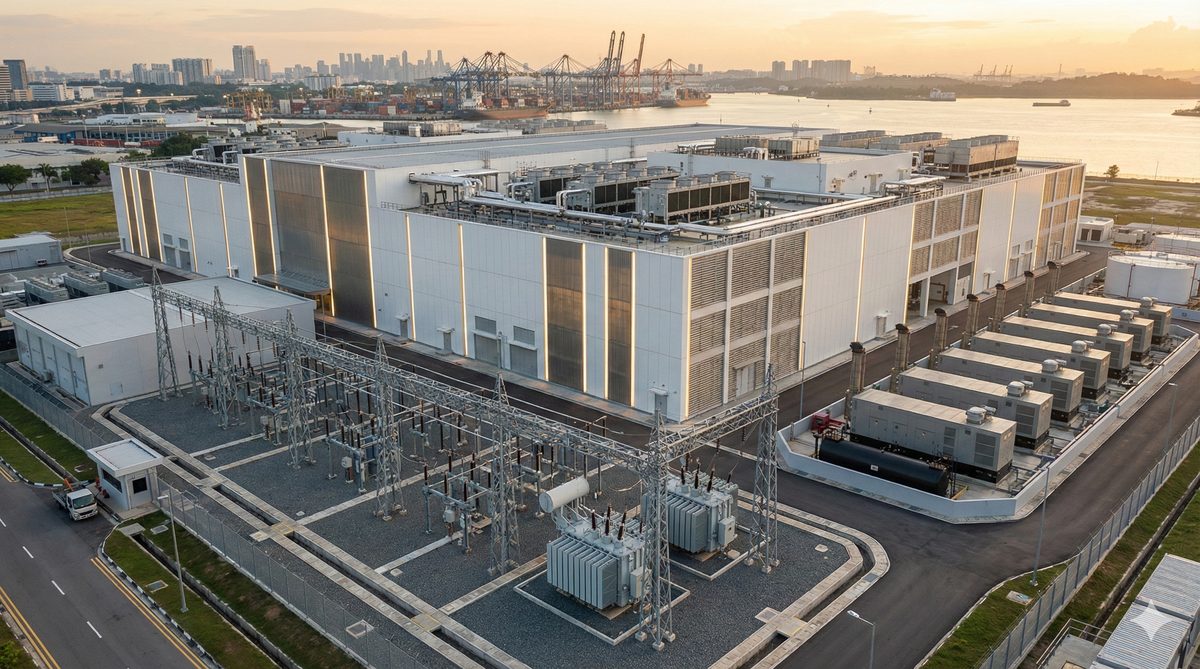
Comprehensive operational expenditure analysis with 30+ countries, climate-adjusted calculations, and flexible staffing models
CAPEX gets the boardroom attention. OPEX is what actually kills the margin — year after year, silently.
Energy alone can eat 40–60% of your annual operating budget, and that's before you factor in staffing models, maintenance contracts, climate-driven cooling penalties, and the 30+ country-specific variables that turn a "simple" cost projection into a guessing game. This calculator maps all of it: pick your country, set your IT load, choose between in-house, hybrid, or outsourced staffing, and see how geography and climate reshape the numbers. It won't replace a full financial model — but it will show you where the real cost drivers hide, before they show up in your P&L.
30+ countries with local rates 3 staffing models Climate-adjusted PUE Full cost breakdown
General-purpose estimate — actual OPEX varies with contract terms, utility tariffs, and operational maturity. Need a tailored projection? Let's talk.
B
Scenario B Input
Modify the inputs below to configure Scenario B for comparison
Location
🇮🇩
Labor:1.00x | Energy:$0.075/kWh
Facility Parameters
1.50
1.1 (Best)2.0 (Legacy)
70%
Climate & System Config
Cooling Energy:1.00x | Free Cooling:0 hrs/yr
Staffing Model
Staffing Model
Choose how to staff your data center operations.
Model
Effect
In-House
Full headcount, lower per-person cost
Partial (Hybrid)
Blended efficiency
Full Contractor
~30% fewer FTE, higher per-person rate, net 10-15% savings
Contractor: fewer staff (multi-skilled), no training/cert cost, but higher OEM maintenance rates. Management stays in-house.
In-House
100% Own Staff
Full In-House Model
All operations staff are direct employees on your payroll.
FTE Count
Full headcount (~23 FTE for 1MW Tier 3)
Cost Factor
1.42x base salary (BPJS, THR, leave, overhead)
Training
Owner funds all: K3 Listrik, manufacturer certs, safety training
Spare Parts
Owner manages & funds 100% of critical spare parts inventory
Maintenance
In-house labor = baseline cost (no OEM premium)
Partial
Hybrid Mix
Partial (Hybrid) Model
Blend of in-house management + outsourced technical staff.
Management
Biased toward in-house (+20% above slider)
Technicians
Split per slider; contractor portion gets efficiency benefit
Support
Biased toward contractor (-20% below slider)
Spare Parts
Shared: ~55% owner-managed, rest under contractor scope
Maintenance
Blended OEM factor based on contractor percentage
Use the slider to adjust the in-house / contractor ratio (10%-90%).
Contractor
100% Outsource
Full Contractor Model
All technical operations outsourced to a maintenance contractor (All-Risk contract).
FTE Reduction
~30-35% fewer people (multi-skilled workers)
Cost Factor
1.75x base salary (margin, overhead, profit)
Training
Contractor handles all: K3, manufacturer certs, LOTO, etc.
Spare Parts
Contractor holds 85% under All-Risk warranty; owner keeps 15% buffer
Maintenance
OEM premium (1.8-2.5x) but contractor absorbs corrective risk
Management (Facility Mgr, Maintenance SPV) stays in-house for oversight. 1 Contract Admin added for permit/work order management.
In-House: 70%Contractor: 30%
Year & Energy Contract
Contracts & Coverage
Staffing Details
ANNUAL OPEX SUMMARY
🇮🇩Indonesia
$1,245,000
Total Annual Operational Expenditure
Total OPEX
Annual operational expenditure including staffing, maintenance, energy, insurance, and other recurring costs to run the facility.
$103.8K
Per Month
Monthly OPEX
Total annual OPEX divided by 12 months. Useful for budgeting and cash flow planning.
$1,245
Per kW/Year
OPEX per kW/Year
Industry benchmark: Total OPEX ÷ IT Load. Typical range: $800-2,000/kW/year depending on location and tier level.
$0.14
Per kWh
Effective $/kWh
Total OPEX divided by annual energy consumption. Combines electricity cost with all other operating costs per kWh delivered.
24
Total FTE
Full-Time Equivalent
Total staff headcount required. Includes management, engineers, technicians, operators, and support staff. Covers 24/7 shift operations.
OPEX Uncertainty & Sensitivity
Monte-Carlo range
A 4,000-run Monte-Carlo around your annual OPEX, varying energy price (the dominant, volatile driver), PUE drift, and labor/maintenance escalation. P10/P50/P90 = optimistic / most-likely / conservative. The tornado ranks which driver moves OPEX most. Powered by RZEngine v2.0.
$/kW/Year = category cost divided by IT Load. Industry benchmark for total OPEX: $800-2,000/kW/yr.
Category
Annual Cost
% of Total
$/kW/Year
Distribution
Staffing Breakdown
Staffing Cost Detail
Full personnel breakdown by role, split between in-house and contractor staff.
Column
Description
FTE
Full-Time Equivalents (actual headcount after efficiency)
In-House
Your direct employees (salary × 1.42x for BPJS, THR, leave, etc.)
Contractor
Outsourced staff (salary × 1.75x for margin, overhead, profit)
Annual Cost
Total cost = In-House cost + Contractor cost per role
Contractor model: Multi-skilled workers reduce FTE by ~30-35%. Management (Facility Manager, Maintenance Supervisor) always stays in-house for oversight.
Full In-House
Role
FTE
Full-Time Equivalent
Total headcount for this role after contractor efficiency adjustments. In-House: full count. Contractor: ~65-85% of base count due to multi-skilled workers covering multiple roles.
In-House
In-House Staff
Direct employees on your payroll. Cost includes: base salary × 13 months (THR), BPJS (health + employment), annual leave provision, and overhead (1.42x multiplier).
Contractor
Contractor Staff
Outsourced to maintenance contractor. Rate includes: contractor margin (15-20%), worker insurance, PPE, tools, supervision, and profit (1.75x multiplier). Contractor handles their own training, K3 certifications, and manufacturer courses.
Annual Cost
TOTAL
24
24
0
$485,000
Maintenance & Spare Parts Breakdown
Maintenance & Spare Parts
Preventive/corrective maintenance costs and critical spare parts inventory budget.
K3 Listrik, AMDAL, SLO, Izin Operasi, BNSP certifications
Compliance (Intl)
ISO 27001, SOC 2, PCI-DSS, Uptime Tier certification
Indonesia: K3 Listrik (Ahli K3 Listrik) certification is mandatory for all electrical installations above 197 kVA. Renewal is typically annual or biennial.
Indonesia Standards
Item
Annual Cost
Notes
Renewal
Distribution
TOTAL INSURANCE & COMPLIANCE
$63,000
-
-
-
Staffing Model Comparison
Quick Staffing Comparison
Live comparison of total OPEX under each staffing model, using your current configuration (country, IT load, tier, cooling, etc.).
Model
Key Characteristics
In-House
Full headcount, lower rate/person, owner manages all spares & training
~30-35% fewer FTE, higher rate/person, contractor holds spare parts & training
This is a quick comparison only. Use "Save Scenario A" + change inputs for a full side-by-side comparison with different configurations.
Full In-House
In-House Baseline
All staff on payroll (1.42x multiplier). Full headcount, owner manages spares & training. OEM maintenance at baseline cost. This is the reference point for comparison.
$1,312,000
Baseline
Partial (70/30)
Partial Model
70% in-house, 30% contractor (fixed for this comparison). Management biased in-house. Contractor portion benefits from FTE efficiency. Shared spare parts responsibility.
$1,245,000
-5.1% vs In-House
Full Contractor
All-Risk Contractor
~30% fewer FTE (multi-skilled), 1.75x rate, but contractor absorbs: training, K3 certs, 85% spare parts, corrective maintenance risk. OEM premium on maintenance. Net: typically 8-15% cheaper total OPEX.
$1,198,000
-8.7% vs In-House
All content on ResistanceZero is independent personal research derived from publicly available sources. This site does not represent any current or former employer. Terms & Disclaimer
Disclaimer & Data Sources
This calculator is provided for educational and estimation purposes only. Results are approximations based on industry benchmarks and publicly available data. They should not be used as the sole basis for investment, procurement, or engineering decisions. Always consult qualified professionals for site-specific analysis.
Algorithm & methodology sources: Uptime Institute operational benchmarking, US EIA commercial electricity rates, BLS staffing models, JLL Data Center Outlook, CBRE operational cost indices, IEC 62040 UPS efficiency standards.
All calculations are performed entirely in your browser. No data is transmitted to any server. See our Privacy Policy for details.
By using this tool you agree to our Terms. All content on ResistanceZero is independent personal research. This site does not represent any current or former employer.
Free estimate · Sign in for the full analysis — Rp 199K/bulan