The Global Preparedness Awakening
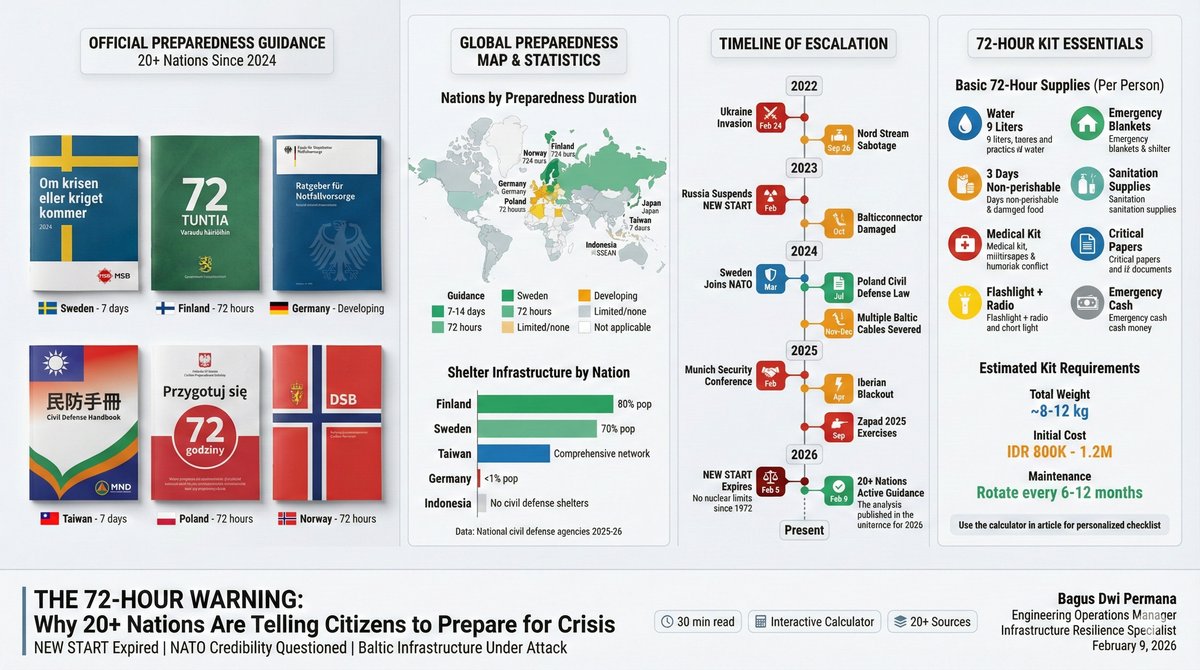
Governments across Europe, East Asia, and the Americas have issued guidance on household supplies and continuity during a crisis. The recommendations vary by country and by the disruptions each government is planning for.
The message is consistent: Be ready to survive on your own for at least 72 hours. Some countries are pushing further — 1 week, even 2 weeks of self-sufficiency.
The guidance reflects preparedness policy. The following sections examine the security and infrastructure risks behind the updates in 2025-2026.
The Core Message
Over 20+ nations have issued or updated civilian emergency preparedness guidance since 2024.
The common thread: Citizens should be prepared to survive 72 hours to 2 weeks without government assistance.
This represents the most significant expansion of civil defense messaging since the Cold War.
Key Takeaways (2-Minute Summary)
- NEW START expired Feb 5, 2026 — First time since 1972 with no nuclear arms limits between US & Russia
- NATO Article 5 questioned — European allies accelerating self-reliance after Munich 2025 concerns
- Infrastructure under attack — 10+ Baltic cables damaged, GPS jamming up 3,000% in some regions
- 20+ nations issuing guidance — Sweden, Finland, Taiwan, Germany, Poland all urging 72-hour to 2-week preparedness
- Action required — Use the interactive calculator below to build your personalized emergency kit
Reading time: 30 minutes for full analysis | Skip to Calculator | View Sources
1. The Geopolitical Context: Why Now?
To understand this phenomenon, we must examine the cascading security developments that have led governments to conclude civilian preparedness is now essential.
1.0 The Ukraine-Russia Conflict: The Catalyst
The Russian invasion of Ukraine in February 2022 fundamentally shattered the post-Cold War European security architecture. Now entering its fourth year, the conflict has:
- Demonstrated modern warfare realities: Cities under siege, infrastructure systematically targeted, civilian populations displaced on a scale not seen in Europe since 1945
- Exposed energy vulnerabilities: Europe's dependence on Russian gas became a strategic weakness exploited during the conflict
- Triggered the largest military buildup since the Cold War: NATO members rapidly increasing defense spending and troop deployments to Eastern Europe
- Proven that large-scale conventional war in Europe is possible: An assumption many had dismissed as obsolete
The Preparedness Driver: Every European nation's updated civil defense guidance explicitly or implicitly references the Ukraine conflict as the catalyst for reassessing civilian resilience. The war demonstrated that modern infrastructure — power grids, communications, water systems — can be systematically degraded, requiring citizens to be self-sufficient for extended periods.
The conflict's ongoing nature, with no clear resolution in sight as of early 2026, has transformed European security thinking from "if" to "when" regarding potential spillover or escalation scenarios.
Timeline: The Escalation Path (2022-2026) — From Ukraine to Epic Fury, Greenland & Trade War
Timeline shows key events driving the global preparedness push. Click sections below for detailed analysis.
1.1 NEW START Treaty Expiration (February 5, 2026)
For the first time since 1972, there are no limits on U.S. and Russian nuclear arsenals. The NEW START treaty, which capped deployed strategic nuclear warheads at 1,550 for each side, expired on February 5, 2026, after Russia suspended participation in 2023 and no successor agreement was reached.
Historic Milestone: This marks the first time in 54 years that the two largest nuclear powers have no binding constraints on their strategic nuclear forces. The previous era of unrestricted nuclear competition led to arsenals exceeding 30,000 warheads each.
The implications are profound:
- No inspection regime: Neither side can verify the other's arsenal or activities
- No deployment caps: Both sides can now expand deployed warheads without treaty violation
- Increased uncertainty: Strategic planners must assume worst-case scenarios
- Potential arms race: Both Russia and the U.S. have announced modernization programs
1.2 NATO Article 5 Credibility Concerns
The Munich Security Conference in February 2025 saw unprecedented public questioning of NATO's collective defense commitment. Comments from senior U.S. officials, including Vice President Vance, suggesting that Article 5 might not automatically trigger a response, sent shockwaves through European capitals.
"The question is no longer whether NATO will respond — it's how quickly and with what force. That uncertainty is precisely what deterrence was supposed to prevent."
— Munich Security Report 2025, reflecting widespread European defense community concerns
This has accelerated European self-reliance initiatives:
- Poland: Military spending increased to 4.5% of GDP (SIPRI Military Expenditure Database)
- Germany: Bundeswehr modernization accelerated
- Nordic countries: Rapid NATO integration and domestic preparedness
- Baltic states: Comprehensive civil defense revival
1.3 Zapad 2025: Military Exercises with Nuclear Scenarios
Russia's Zapad 2025 military exercises, conducted in September-October 2025, were the largest since the Cold War. Intelligence assessments indicated the exercises included:
- Simulated nuclear strike planning against NATO targets
- Electronic warfare disruption of civilian infrastructure
- Mobilization of reserve forces at unprecedented scale
- Coordination with Belarusian military for potential western operations
The exercises coincided with increased submarine activity in the North Atlantic and Baltic Sea, raising concerns about undersea cable vulnerability.
1.4 Baltic Sea Infrastructure Sabotage
Since 2022, at least 10 undersea cables and pipelines in the Baltic Sea have been damaged under suspicious circumstances (Reuters coverage, national government statements):
Cables Damaged
Countries Affected
Repair Time
Redundancy
Notable incidents include:
- Nord Stream pipelines (Sept 2022): Unprecedented sabotage of major energy infrastructure
- Balticconnector (Oct 2023): Finland-Estonia gas pipeline damaged by ship anchor
- C-Lion1 cable (Nov 2024): Finland-Germany telecommunications cable severed
- Multiple cables (Dec 2024 - Jan 2025): Sweden-Lithuania, Latvia-Sweden connections damaged
1.5 GPS Jamming Epidemic
The Baltic and Nordic regions have experienced an unprecedented increase in GPS interference:
| Country | GPS Interference Incidents | Year-over-Year Change | Peak Month |
|---|---|---|---|
| Estonia | 85% of flights affected at peak | +400% | March 2025 |
| Latvia | 31x increase in jamming events | +3,000% | February 2025 |
| Finland | Widespread disruption | +250% | April 2025 |
| Poland | Eastern border zone affected | +180% | March 2025 |
Sources: Eurocontrol Network Manager Reports, National aviation authorities, GPSJAM.org live data For educational and research purposes only.
The jamming affects:
- Commercial aviation navigation
- Emergency services coordination
- Maritime navigation in congested shipping lanes
- Agricultural equipment and logistics
- Telecommunications timing systems
1.6 China-Taiwan Gray Zone Intensification
Cross-strait tensions have escalated significantly:
- Daily incursions: PLA aircraft crossing the Taiwan Strait median line have become routine
- Naval exercises: Increased frequency and scale of encirclement drills
- Cable threats: Submarine cables connecting Taiwan to the global internet face increased risk
- Civilian preparedness: Taiwan has issued comprehensive civil defense guidance
1.7 2025 Iberian Blackout: A Warning
The April 2025 blackout affecting Spain and Portugal demonstrated the fragility of modern infrastructure:
The Iberian Blackout: A grid synchronization failure cascaded across the Iberian Peninsula, affecting 50+ million people. Power was restored within hours, but the incident exposed critical vulnerabilities in interconnected systems and the speed at which modern societies can be paralyzed.
Key lessons:
- Modern infrastructure is highly interdependent
- Cascading failures can occur rapidly
- Even short disruptions cause significant societal stress
- Natural and technical failures can have attack-like effects
1.8 Operation Epic Fury: The Iran Escalation (February 28, 2026)
In perhaps the most significant military escalation of the decade, the United States and Israel launched a coordinated assault on Iran on February 28, 2026. The operation — codenamed "Epic Fury" by the US and "Roaring Lion" by Israel — came just one day after Oman's Foreign Minister announced a diplomatic breakthrough in nuclear talks.
Operation Scale: Israel deployed approximately 200 fighter jets — the largest aerial operation in IAF history — striking ~500 targets across western and central Iran. The US launched Tomahawk cruise missiles from naval assets and debuted the LUCAS "kamikaze" drone system in its first combat deployment. Strikes hit 24 of Iran's 31 provinces.
The operation's stated objectives were fourfold: (1) prevent Iran from acquiring nuclear weapons, (2) destroy its missile arsenal and production capacity, (3) degrade proxy networks, and (4) eliminate its naval capability. President Trump explicitly called for regime change, urging Iranians to "take over your government."
The Escalation Path to Epic Fury
This was not a sudden development. The Iran-Israel conflict had been escalating through a series of increasingly direct confrontations:
- October 7, 2023: Hamas attack on Israel triggers Gaza war — Iran-backed proxy conflict intensifies
- April 2024: Iran and Israel exchange direct missile strikes for the first time in history
- July 2024: Israel assassinates Hamas leader Ismail Haniyeh inside Tehran
- September 2024: Israel kills Hezbollah leader Nasrallah and IRGC commander Nilforoushan
- June 2025: The 12-Day War — Israel launches surprise attack on Iran; US deploys B-2 stealth bombers with GBU-57 bunker busters against Fordow, Natanz, and Isfahan nuclear facilities; Iran retaliates with 550+ ballistic missiles and 1,000+ drones
- Late 2025: Iran rebuilds — new roof constructed at Isfahan; accelerated work at "Pickaxe Mountain" facility near Natanz
- February 28, 2026: Operation Epic Fury — the culmination
Immediate Consequences
Iran retaliated within hours, launching ballistic missiles at Israel and US military bases across seven countries — Jordan, Syria, Kuwait, Bahrain, Qatar, Saudi Arabia, and the UAE. Qatar alone was targeted by 44 missiles and 8 drones. Residential areas near Dubai Marina and Palm Jumeirah were struck, setting the Fairmont The Palm hotel on fire.
Strait of Hormuz Disruption: Iran's IRGC effectively closed the Strait of Hormuz, through which one-quarter of the world's seaborne oil trade (~20 million barrels/day) and one-fifth of global LNG passes. Oil prices surged 3.7% immediately, with JPMorgan warning crude could exceed $100/barrel in a severe scenario.
Senior Iranian leadership was decimated: Supreme Leader Khamenei was confirmed killed, along with IRGC commander Pakpour, Defense Minister Nasirzadeh, adviser Shamkhani, and Armed Forces chief Bagheri. Iran's Red Crescent reported 201+ killed and 700+ injured, with estimated damages of $17.8 billion.
Civilian Impact
Oil Market Shock
Gulf Retaliation
Preparedness Implications
The operation carries profound implications for civilian preparedness worldwide:
- Tehran has virtually no public bomb shelters — the mayor had acknowledged they would take years to build, leaving millions unprotected
- Gulf states in the crossfire: Qatar, Bahrain, and Kuwait shifted to remote learning; populations near US bases were evacuated or sheltered
- Energy supply chain disruption: Hormuz closure threatens global energy security, potentially cascading into power grid stress across import-dependent nations in Asia and Europe
- Multiple nations had pre-ordered evacuations: Poland, Finland, Cyprus, Sweden, Serbia, and South Korea ordered citizens to leave Iran days before the strikes — suggesting advance intelligence sharing
- Canada issued shelter-in-place guidance: Citizens were told to stock up on supplies — exactly the kind of 72-hour preparedness this article analyzes
Key Takeaway: The Iran strikes demonstrate that the preparedness guidance analyzed in this article is not theoretical. Within 48 hours of Operation Epic Fury, multiple nations activated precisely the kind of civilian resilience frameworks discussed in Section 2. The convergence of nuclear uncertainty, energy disruption, and direct military conflict makes 72-hour self-sufficiency more relevant than ever.
1.9 The Greenland & Arctic Crisis: Sovereignty Under Pressure
While the world focused on the Middle East, a different kind of security crisis was unfolding in the Arctic. The United States began an unprecedented campaign to acquire Greenland from Denmark — a NATO ally — through a combination of economic coercion, military posturing, and diplomatic pressure.
Strategic Stakes: Greenland holds an estimated 25% of the world's undiscovered rare earth minerals — critical for semiconductors, defense systems, and renewable energy. The island also controls the GIUK Gap (Greenland-Iceland-UK), a chokepoint for Russian submarine access to the Atlantic. The US already operates Pituffik Space Base (formerly Thule Air Base), its northernmost military installation.
The Escalation Path
The Greenland crisis escalated through a series of increasingly aggressive moves:
- December 2025: President Trump appointed Ken Howery as special envoy to Greenland and publicly stated the island was essential to US national security
- January 2026: The US imposed 25% tariffs on Danish goods, explicitly as leverage for Greenland negotiations. Trump refused to rule out military force to acquire the territory
- January 15, 2026: Denmark launched Operation Arctic Endurance — deploying the frigate HDMS Absalon alongside vessels from 11 NATO nations to patrol Arctic waters, the largest Danish military deployment since World War II
- January 21, 2026: At the World Economic Forum in Davos, Trump pivoted from outright annexation to a "Strategic Partnership Agreement," proposing joint development of rare earth resources
- February 2, 2026: The US announced Project Vault — a $12 billion rare earth mining initiative in Greenland, designed as a joint venture but with significant American control provisions
NATO Alliance Under Strain: The Greenland crisis marks the first time in NATO's 77-year history that a member state has threatened another member with economic sanctions and implied military force over territorial acquisition. Denmark's Prime Minister Mette Frederiksen called emergency consultations with Nordic allies and accelerated defense spending to 3.5% of GDP.
Preparedness Implications
The Arctic crisis carries distinct preparedness implications that differ from conventional military threats:
- Alliance reliability questioned: If the US is willing to coerce a NATO ally, the security guarantees underlying European preparedness frameworks face existential doubt
- Arctic infrastructure vulnerability: Undersea cables, oil pipelines, and military communication links in the Arctic are increasingly contested — with both Russian and Chinese interests expanding
- Rare earth supply chain risk: China currently controls ~60% of rare earth mining and ~90% of processing. US moves to secure Greenland's deposits signal potential supply chain fragmentation that would affect everything from smartphones to missile guidance systems
- Nordic preparedness surge: Denmark ordered snap elections for March 24, 2026, with Greenland sovereignty as the central issue. Sweden, Finland, and Norway coordinated joint civil defense exercises in response
Rare Earth Control
Arctic Military
Economic Coercion
1.10 Panama Canal, Trade Wars & the Fragmentation of Global Commerce
The Greenland crisis did not occur in isolation. Simultaneously, the US moved to assert control over the Panama Canal — one of the world's most critical trade chokepoints — while a global trade war threatened the economic foundations of civilian supply chains.
Panama Canal: CK Hutchison Forced Out
In February 2026, Hong Kong-based CK Hutchison Holdings was compelled to annul its long-standing concession to operate ports at both ends of the Panama Canal. The US government had characterized the Chinese-linked company's presence as a national security threat, citing intelligence concerns over surveillance and potential canal disruption during a Taiwan contingency.
- BlackRock-led consortium was pre-positioned to assume operations, signaling a strategic public-private partnership model for critical infrastructure control
- China responded with retaliatory measures, including antitrust investigations into CK Hutchison and warnings of consequences for companies complying with US pressure
- Panama's sovereignty was tested: The canal's 1999 handover by the US was meant to be permanent — the forced concession change raises questions about the durability of any infrastructure agreement
The Trade War Escalation
The broader trade war added a systemic economic dimension to civilian preparedness concerns:
- February 20, 2026: The US Supreme Court ruled that the International Emergency Economic Powers Act (IEEPA) does not authorize tariffs — a landmark decision that temporarily invalidated the legal basis for existing trade measures
- The administration pivoted to Section 122 of the Trade Act, which allows temporary 15% surcharges for up to 150 days during balance-of-payments emergencies
- China imposed retaliatory tariffs of 10-15% on US agricultural and energy exports, while the EU announced counter-tariff preparations on American goods worth €21 billion
Supply Chain Preparedness Impact: Trade fragmentation directly affects civilian preparedness. When import costs rise 15-25%, essential goods become more expensive and supply chains less reliable. Pharmaceutical imports, food staples, and energy costs — the foundations of 72-hour preparedness — are all vulnerable to trade disruption. The EU's new Preparedness Union Strategy explicitly cites trade instability as a civil protection trigger.
Panama Canal
Trade War
EU Response
Key Takeaway: The convergence of the Iran strikes, Arctic sovereignty crisis, Panama Canal control, and global trade war represents an unprecedented multi-front fragmentation of the international order. Each crisis individually justifies civilian preparedness; together, they demonstrate that the 72-hour framework is not merely about military conflict — it encompasses energy disruption, trade collapse, supply chain fragmentation, and alliance instability. Governments issuing preparedness guidance are responding to this full spectrum of threats.
2. Country-by-Country Preparedness Mandates
The following table summarizes official government preparedness guidance across major democracies:
| Country | Preparedness Duration | Official Guidance | Shelter Status | Status |
|---|---|---|---|---|
| SESweden | 1 week (7 days) | "If Crisis or War Comes" brochure | 65,000 shelters (7M capacity) | Active |
| FIFinland | 72 hours minimum | 72 Hours - Prepare for Disruptions | 50,000+ shelters (4.5M capacity) | Active |
| NONorway | 72 hours | DSB preparedness guidance | Shelter renovation program | Active |
| DKDenmark | 72 hours | DEMA civil preparedness | Limited public shelters | Active |
| EEEstonia | 72 hours | Rescue Board guidance | Shelter expansion planned | Active |
| LVLatvia | 72 hours | Civil protection guidance | Soviet-era shelters assessed | Active |
| LTLithuania | 72 hours | PAGD preparedness guide | Shelter renovation ongoing | Active |
| DEGermany | 10 days | BBK civil protection concept | 579 shelters (83M population gap) | Limited |
| PLPoland | 72 hours (mandated) | Civil defense law 2024 | Shelter construction program | Active |
| EUEU-wide | 72 hours recommended | Preparedness Union Strategy | Member state responsibility | Active |
| TWTaiwan | 1 week (7 days) | Civil Defense Handbook | Comprehensive shelter network | Active |
| JPJapan | 2 weeks shelter capacity | Cabinet Office guidance | Designated evacuation sites | Active |
| KRSouth Korea | 72 hours | Civil defense drills mandatory | 17,000+ public shelters | Active |
| IDIndonesia | No specific guidance | Natural disaster focus only | No civil defense shelter network | None |
| ASEANASEAN Region | Variable | Natural disaster focused | Limited infrastructure | Limited |
Source: Publicly available industry data and published standards. For educational and research purposes only.
2.1 The German Shelter Gap
Germany presents a stark example of the Cold War drawdown in civil defense (BBK - Federal Office of Civil Protection):
Cold War Peak
Current Status
Population
Coverage Gap
Following decades of "peace dividend" thinking, Germany is now rapidly reassessing its civil defense posture. The BBK (Federal Office of Civil Protection) has issued updated guidance, but infrastructure rebuilding will take years.
2.2 The Nordic Model
Sweden and Finland never fully dismantled their Cold War civil defense infrastructure. Sweden maintained (MSB - Swedish Civil Contingencies Agency):
- 65,000 shelters capable of protecting 7 million people
- Mandatory building codes requiring shelter space in new construction
- Regular maintenance and inspection programs
- Public awareness campaigns ("If Crisis or War Comes" brochure)
Finland's approach is even more comprehensive, with shelter capacity for approximately 80% of its population (Finnish Ministry of the Interior).
2.3 Indonesia and ASEAN Context
It's notable that Indonesia and most ASEAN nations have not issued similar 72-hour preparedness guidance for security-related scenarios. Existing emergency preparedness focuses on natural disasters (earthquakes, tsunamis, volcanic eruptions) rather than conflict or infrastructure disruption.
Indonesian Context: While BNPB (National Disaster Management Agency) provides natural disaster preparedness guidance, there is no equivalent to the Nordic or East Asian civil defense frameworks for security-related emergencies. This represents a potential gap as regional tensions evolve.
3. Cold War Comparison: Then and Now
The current preparedness push represents a return to Cold War-era civil defense thinking, but with key differences:
| Aspect | Cold War Era | Current Era |
|---|---|---|
| Primary Threat | Nuclear war between superpowers | Hybrid warfare, infrastructure attack, regional conflict |
| Warning Time | Minutes to hours (ICBM) | Days to none (cyber, sabotage) |
| Infrastructure Dependency | Lower (more analog systems) | Extreme (digital, interconnected) |
| Public Awareness | High (duck and cover drills) | Low (peace dividend generation) |
| Shelter Infrastructure | Extensive (many demolished) | Degraded or non-existent in many countries |
| Self-Sufficiency Culture | Higher (less just-in-time) | Lower (globalized supply chains) |
Source: Publicly available industry data and published standards. For educational and research purposes only.
4. What the 72-Hour Guidance Actually Recommends
Across all the national guidance documents, common themes emerge for household preparedness:
4.1 Water
- Minimum 3 liters per person per day for drinking
- Additional water for cooking and hygiene
- Water purification tablets or filters as backup
- Knowledge of local water sources
4.2 Food
- Non-perishable items requiring minimal preparation
- High-calorie, nutrient-dense options
- Consideration for dietary restrictions and allergies
- Manual can opener (no electricity assumption)
4.3 Power and Communication
- Battery-powered or hand-crank radio
- Flashlights and spare batteries
- Power banks for mobile devices
- Cash (ATMs may not function)
4.4 Medical and Hygiene
- First aid kit with essential supplies
- Prescription medications (2-week supply minimum)
- Hygiene supplies for sanitation without running water
- Important documents in waterproof container
5. Interactive 72-Hour Survival Kit Calculator
Use this calculator to generate a personalized 72-hour emergency kit checklist based on your household composition, location, and specific needs. Hover over the question mark icons for detailed explanations of each parameter.
Generate a personalized survival checklist with cost and weight estimates
Your Personalized Shopping Checklist
How to use: Check off items as you purchase or gather them. This list is customized based on your family size, pets, medical needs, and climate. Use it as your shopping guide when preparing your emergency kit.
Note: Cost estimates are approximate based on 2026 prices. Actual costs may vary by location and retailer. Consider rotating perishable items every 6-12 months.
Disclaimer & Data Sources
This calculator provides educational estimates only and should not replace professional emergency planning guidance. Actual preparedness needs vary by household size, location, and specific risk factors.
Algorithm & Methodology: Cost estimates based on 2026 average retail prices. Water requirements follow WHO minimum standards (2.5-3L/person/day). Food calculations based on BNPB emergency preparedness guidelines. Supply duration recommendations aligned with Swedish MSB "Om krisen eller kriget kommer" framework.
All calculations run entirely in your browser — no data is collected or transmitted. Privacy Policy · Terms & Disclaimer
6. Why Governments Are Acting Now
The simultaneous global push for civilian preparedness reflects several converging assessments:
6.1 Hybrid Warfare Recognition
Military planners now acknowledge that future conflicts may not begin with obvious military action. Infrastructure disruption, cyber attacks, and "gray zone" activities can precede or substitute for conventional warfare.
6.2 Just-in-Time Vulnerability
Modern supply chains operate on just-in-time principles with minimal inventory. Supermarkets typically hold 3 days of stock; pharmacies even less. Any disruption cascades rapidly through society.
6.3 Digital Dependency
Critical infrastructure — power, water, communications, financial systems — depends on interconnected digital systems vulnerable to cyber attack or physical disruption. In Southeast Asia, the rapid data center expansion is simultaneously creating new digital infrastructure and new vulnerabilities.
6.4 Reduced Surge Capacity
Emergency services are optimized for normal operations. Large-scale crises can overwhelm response capacity within hours, making civilian self-sufficiency essential.
7. What This Means for Southeast Asia
While this analysis has focused on European and East Asian preparedness efforts, the implications for Southeast Asia, including Indonesia, merit consideration:
Opportunity for Proactive Planning: Rather than waiting for crisis to drive policy, Southeast Asian nations can learn from the Nordic and East Asian models to develop appropriate preparedness frameworks tailored to regional risks — whether from natural disasters, regional tensions, or infrastructure vulnerabilities. The $37 billion data center investment wave sweeping the region makes infrastructure resilience planning more urgent than ever.
Key considerations for the region:
- Natural disaster preparedness as foundation: Existing earthquake, tsunami, and volcanic emergency systems can be expanded
- Submarine cable vulnerability: Southeast Asia's internet connectivity depends on undersea cables that could be disrupted
- Regional tension spillover: South China Sea tensions could affect shipping and regional stability
- Supply chain concentration: High dependence on specific trade routes and suppliers
8. Conclusion: Preparedness is Not Panic
The global push for 72-hour civilian preparedness is not about creating fear — it's about building resilience. The governments issuing this guidance are not predicting imminent catastrophe; they're acknowledging that the risk environment has changed and that prepared citizens are more resilient citizens.
"If you are prepared, you will be able to help not only yourself but also your neighbors and community. Preparedness is not about panic — it is about responsibility."
— Swedish Civil Contingencies Agency (MSB)
This community-first mindset is already manifesting in the data center industry, where organized community opposition has blocked $64 billion in projects globally — demonstrating that local resilience and collective action remain powerful forces even in the age of digital infrastructure.
The key takeaways:
- Global security environment has fundamentally changed since 2022
- Infrastructure vulnerability is real and demonstrated by recent events
- 72-hour self-sufficiency is a reasonable baseline for any household
- Preparedness reduces burden on emergency services when they're most needed
- The time to prepare is before a crisis, not during one
Whether you live in Stockholm, Taipei, or Jakarta, the underlying logic is the same: modern societies are more fragile than they appear, and individual preparedness contributes to collective resilience.
Action Item
Use the calculator above to assess your household's preparedness needs. Start with the basics — water, food, first aid — and build from there. Even partial preparedness is better than none.
All content on ResistanceZero is independent personal research derived from publicly available sources. This site does not represent any current or former employer. Terms & Disclaimer
References & Official Sources
- Om krisen eller kriget kommer (If Crisis or War Comes) Swedish Civil Contingencies Agency (MSB) — Official preparedness brochure
- EU Preparedness Union Strategy European Commission — EU-wide preparedness framework
- Taiwan Civil Defense Handbook Taiwan Ministry of National Defense — Civilian emergency preparedness guide
- 72 Hours - Prepare for Disruptions Finnish Ministry of the Interior — National preparedness guidance
- Federal Office of Civil Protection and Disaster Assistance (BBK) German Federal Government — Civil protection resources
- Norwegian Directorate for Civil Protection (DSB) Norwegian Government — Emergency preparedness guidance
- Arms Control Association — NEW START Treaty Fact Sheet Analysis of nuclear arms control frameworks and treaty status
- Eurocontrol — GPS Interference Reports Aviation safety data on GPS jamming incidents across European airspace
- Munich Security Report 2025 NATO alliance discussions, deterrence debates, and collective defense statements
- Baltic Sea Cable Incident Reports (2022-2026) Reuters and national sources documenting Nord Stream, Balticconnector, and C-Lion1 incidents
- GPSJAM.org — Live GPS Interference Map Real-time tracking of GPS jamming and spoofing incidents globally
- NATO — Collective Defence Article 5 Official NATO documentation on mutual defense obligations
- IEA — World Energy Outlook 2025 International Energy Agency analysis on energy security and infrastructure
- Buku Panduan Darurat 2026 BENNIX.pdf Panduan kesiapsiagaan darurat untuk masyarakat umum — Emergency preparedness guidebook
- PBS — US and Israel Launch Major Attack on Iran (Feb 28, 2026) Comprehensive reporting on Operation Epic Fury objectives and execution
- Al Jazeera — Why Are the US and Israel Attacking Iran? Analysis of causes, diplomatic context, and the 12-Day War precedent
- Bloomberg — Oil Tankers Avoiding Hormuz Strait Impact on global energy supply chains and oil price implications
- NPR — Iranian Supreme Leader Killed in Israeli Airstrike Confirmation of Khamenei death and leadership succession implications
- CSIS — Operation Epic Fury and Iran's Nuclear Program Strategic analysis of remaining nuclear capabilities after 2025-2026 strikes
- Reuters — Denmark Launches Largest Arctic Military Operation Since WWII Operation Arctic Endurance deployment with 11 NATO nations in response to US pressure on Greenland
- Financial Times — Greenland's Rare Earth Minerals and the New Arctic Race Analysis of Greenland's rare earth deposits and strategic competition between US and China
- Reuters — CK Hutchison Exits Panama Canal Operations Under US Pressure Concession annulment, BlackRock consortium takeover, and China's response
- SCOTUSblog — Supreme Court Rules IEEPA Does Not Authorize Tariffs Landmark ruling on trade war legal basis and pivot to Section 122
- European Commission — EU Preparedness Union Strategy EU framework for civil protection and crisis response citing trade instability